Joyagoo Spreadsheet: Turn Shared Finds into Clear Choices
On this page
A Joyagoo spreadsheet can make a shopping conversation more useful: instead of sending a stream of screenshots, keep the product address, selected version and reason for considering it together. That matters whether you are choosing for yourself, helping a friend compare clothes or planning a purchase for someone else. An attractive find starts the conversation; it does not settle the wearer's preferences.
Begin with the kind of item you need and the decision you want to make. You can browse widely without treating every saved row as a purchase commitment. The strongest shortlist explains both what appeals to you and what would make you reject the item.
Start with the six practical spreadsheet questions
Citești în română? Începe cu ghidul tabelului Joyagoo.
Loed eesti keeles? Alusta Joyagoo arvutustabeli ülevaatest.
Lasi latviski? Sāc ar Joyagoo izklājlapas ceļvedi.
Skaitai lietuviškai? Pradėk nuo Joyagoo prekių sąrašo vadovo.
Whether you call it a Joyagoo sheet or a spreadsheet, keep each row useful: the exact product, chosen option, person making the choice and next unresolved question belong together. A longer list is not a substitute for that clarity.
Use the best Joyagoo spreadsheet comparison when deciding which collection helps you choose. A large catalogue and a helpful collection are not necessarily the same thing.
Use Joyagoo spreadsheet links when you need to reopen the right item without losing the selected size, colour or pack contents. Use the Joyagoo spreadsheet guide when you are ready to move beyond browsing and understand the next shopping step.
Read the Joyagoo spreadsheet review guide to distinguish someone's opinion of a collection from their experience of a delivered item. Before providing personal information or paying, use Joyagoo spreadsheet safety checks. Each question concerns a different part of the same purchase, not a separate reason to trust every row.
Agree on the choice before discussing the order
Start with the category closest to the missing piece in your wardrobe. These guides explain what to compare before opening the product destination:
- Shoes: compare the shape, selected size and intended use.
- T-shirts and hoodies or sweaters: check garment measurements and how the wearer wants the layer to sit.
- Jackets: consider the clothes worn underneath as well as the outer shape.
- Pants and shorts: separate waist, length and preferred fit.
- Sets and jerseys: confirm the selected contents rather than counting everything visible in a photo.
- Headwear, underwear and accessories: check the details relevant to that item instead of reusing a clothing-size assumption.
If the choice crosses categories, keep the pieces separate until each one meets the wearer's needs. Matching colours do not resolve different sizing or contents questions.
If another person will use the item, find out which details they want to choose themselves. A buyer may care about a print, while the wearer cares more about a neckline or where the hem sits. Neither preference should disappear when you save the product.
You can ask a narrow question rather than demanding a complete shopping specification. “Would you wear this shape?” is useful during discovery. “Which of these measurements matches the fit you want?” becomes useful later. Do not treat an enthusiastic reaction to a photo as approval of every size, material claim or payment amount attached to it.
For a top, the T-shirt selection guide explains how to separate a design suggestion from the wearer's fit preferences. The same principle applies to accessories: liking the outside of a bag does not establish that it accommodates what someone carries.
Keep enough information to recover the exact find
For each candidate, save the product destination and the version you inspected. Add the included quantity and the detail that matters most to the decision. An address alone can be insufficient when the page opens with a different option selected on the next visit.
Use a compact row rather than a wall of copied description:
| Field | What to record | Why it helps |
|---|---|---|
| Item | A plain description and product address | Reopens the intended find |
| Option | Colour, size or version considered | Avoids an accidental substitute |
| Contents | The selected quantity and included pieces | Separates a set from a single item |
| Preference | What the wearer likes or needs | Keeps the choice personal |
| Open question | One unresolved detail | Gives the next conversation a purpose |
Keep private information outside that shared row. Someone helping you compare colours does not need the recipient's address, account password or payment record.
Treat a coordinated outfit as several fit decisions
For example, view a T-shirt and shorts set on OG. Before considering it as a complete outfit, inspect the available option and the stated contents. Then ask whether both pieces serve the wearer. Liking the top does not establish that the shorts are the right length or cut.
Do not assume that one familiar size letter fits every piece in a set. Measurements need to describe the relevant garment and use understandable endpoints. If you cannot resolve a feature that matters to the wearer, keep the candidate undecided instead of replacing the answer with a guess.
This example is a product to inspect. Your decision should follow the selected listing's details and the wearer's needs.
Separate price labels from the receiving budget
When you note an amount, write its currency and what it covers. A product figure is not automatically the total cost of receiving a parcel. If a pack contains more than one item, record that quantity before comparing it with a single-piece listing.
Agree on the budget before adding alternatives that change the order. In a shared purchase, one person's “small addition” may still affect the other person's expected spend. Keep the original plan visible so a revised choice is a deliberate decision rather than a quiet expansion.
Do not use a lower price to excuse a failed requirement. A cheaper top that the wearer will not use has not solved the original shopping problem. Likewise, a larger set is not better value merely because its photograph contains more pieces.
Revisit old entries before acting on them
A Joyagoo spreadsheet labelled 2026 can still contain an older product reference. Check the individual destination you intend to use. A familiar thumbnail or a recent page heading does not establish that the option and contents remain unchanged.
If the old item is unavailable or the destination now shows something else, keep the original idea separate from the replacement. Reassess the new listing's measurements and selected version. Details belonging to the former item do not transfer to a similar-looking candidate.
When comparing recommendations, distinguish the person who collected the link from someone who actually received the item. A collection can be easy to browse without proving fit, durability or delivery performance. Repeated shares of the same image do not turn it into several independent experiences.
Finish with an explicit next action
At the end of a browsing session, sort candidates into three useful groups: ready for the next check, waiting for a specific answer, and no longer suitable. There is no need to buy from every group or retain every duplicate suggestion.
For a shared decision, confirm the chosen version in words before moving on. That short confirmation is more reliable than assuming everyone remembers the same screenshot. It also makes later changes easier to discuss: you can point to the altered feature rather than restarting the entire search.
Common questions
Is a Joyagoo spreadsheet itself a checkout?
Treat it as a collection of references. Opening a product, selecting an option and confirming a payment are different actions. Read the destination before proceeding.
Can I use a spreadsheet to choose something for another person?
Yes, but preserve the distinction between your suggestion and their requirements. Let the wearer settle personal preferences that a product photo cannot answer.
Is the newest or largest spreadsheet automatically best?
No. Compare how well the relevant entries help you recover an exact item and make your actual choice. Size and a year label do not establish that by themselves.
Should I retain every saved link?
Keep useful alternatives and references, but remove accidental duplicates from the active shortlist. A saved idea can remain inspiration without becoming an order.
Read in your language
Find the next practical guide
For product decisions, use image search, size comparisons and warehouse QC photos. If you are ready to arrange a parcel, start with shipping, cost estimates and delivery stages.
For an existing order, go directly to payments, returns, tracking or support. Browse the complete article directory for clothing categories, community reviews and language-specific guides.
Checking a year-labelled collection
The useful test for a Joyagoo spreadsheet 2026 is whether it helps you choose an actual item today. A year in the title does not establish that every link, option or price has been checked. Start with the intended wearer's requirements and use the collection to build a shortlist you can explain.
The main Joyagoo spreadsheet guide provides the starting structure. This checklist focuses on reviewing a year-labelled collection before carrying its entries into a new order.
Keep the six main questions connected
You do not need six separate shopping lists to answer the important questions. Use the best spreadsheet guide to judge how useful a collection is, spreadsheet links to preserve the chosen option, and the shopping guide to understand the stages after selection. The review guide and safety checklist help you evaluate claims without treating popularity as proof.
Apply those questions to the same intended purchase. A collection may be easy to browse while a particular entry still lacks a necessary measurement. A clear link can open successfully without establishing that its contents suit the wearer. Resolve the missing information rather than collecting more rows that repeat it.
Build the shortlist around a real requirement
Ask what role the item needs to fill: replacing a worn garment, completing an outfit or providing a particular feature. Keep alternatives separate from confirmed selections. Three similar tops in a saved list are not automatically three items to order.
For another person's clothing, agree on the preferred fit and style before treating a candidate as selected. Keep private measurements outside any publicly shared collection. The size guide explains how to compare the relevant dimensions without assuming a label means the same thing across products.
Choose the category that matches the need. Start with shoes, jackets, T-shirts or accessories rather than letting a large mixed list determine what the wearer should want.
Inspect one row all the way through
Before trusting a collection's convenience, follow a candidate from its description to the actual product page. Check whether the item, version and supplied contents still match. Read the selected option rather than relying on the main image alone.
You can inspect a T-shirt and shorts set on OG as a concrete clothing candidate. Compare what is offered with what the wearer needs from both pieces. This is not a best-of ranking or a verified delivery outcome.
If an entry has a photograph, ask what it shows: a listing image, a warehouse view or an account of later use. These are different kinds of information. The QC guide and haul guide explain why a clear picture does not answer every fit or performance question.
Record the decision, not just the address
Keep a short note beside a chosen product: the option discussed, the requirement it meets and any question still unresolved. That makes the list usable when the buyer returns later or shares it with the wearer.
For example, “candidate; ask about sleeve length” is different from “approved in this colour and size.” Do not let a saved heart, bookmark or copied address stand in for a conversation that has not happened.
If you started with an older collection, the 2025 recovery guide helps preserve the original reference while checking what changed. Updating the year in a file name does not update its underlying entries.
Budget for the selected goods and their parcel
Once the shortlist becomes a purchase plan, compare the product spending with the separate parcel decision. The shipping cost guide helps keep estimates, paid charges and any shared bill clear. Do not promise another person a total based only on a collection's product prices.
Use the coupon-code guide to check an offer against the actual payment. An advertised discount should not persuade you to add clothes the recipient did not choose. Likewise, leave delivery dates conditional until you have relevant shipment information rather than repeating another shopper's timeline.
Recheck when something material changes
A new version, different contents, changed destination or replacement size can affect the decision. Revisit those points before ordering. You do not need to restart the entire list every time, but you do need to resolve changes that matter to the intended use.
Keep credentials, addresses and payment details out of shared entries. A public product reference should let someone discuss the item without gaining access to your account.
Common questions
Is the collection with the most links the best choice?
Not necessarily. A smaller set of relevant, understandable candidates can be more useful than many entries with unclear options. Judge how well it supports the intended purchase.
Does a 2026 label verify a coupon or shipping rate?
No. Check those against the current offer and actual parcel rather than the collection's title.
When is a saved item ready to order?
When the wearer has made the choice and the necessary product, option and purchase questions are resolved—not merely when the link opens.
The Joyabuy name in older discussions
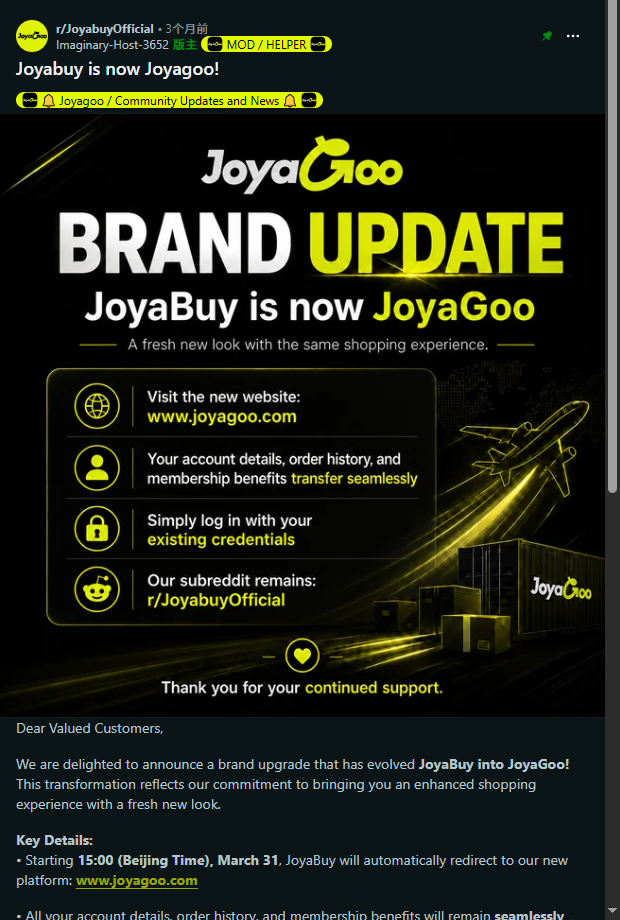
A June 2, 2026 community update recorded the change from JoyaBuy to JoyaGoo.
A dated June 2, 2026 community update recorded the name change from JoyaBuy to JoyaGoo. That context matters because older discussions and saved links may use the earlier spelling, while current searches usually use Joyagoo. Treat both spellings as naming history and use the current catalog structure when looking for a product.